Risk managementQuick answer
Position size formula
Answer
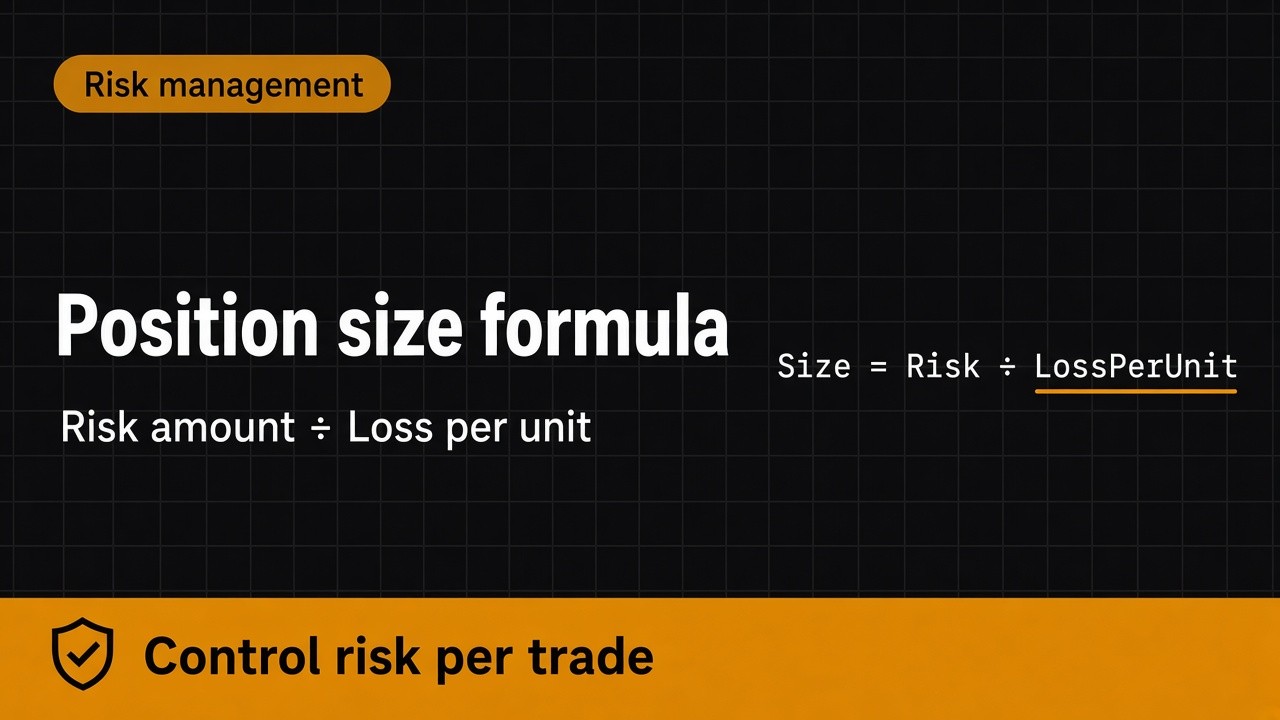
Risk-based position size = (equity × risk%) ÷ (stop distance × value per price unit). In currency terms: size = risk_amount ÷ loss_per_unit. If the stop hits, approximate loss equals the risk amount by construction. For the step-by-step workflow, see How to calculate position size.
Contents
Key definitions
- Formula
- size = (equity × risk_pct) / stop_distance_in_value_per_unit
- risk_amount
- equity × risk_pct
- Example: 10,000 × 1% = 100 account-currency units
- stop_distance
- |entry − stop| in price
- Must match the instrument’s tick/point value conversion
- loss_per_unit
- stop_distance × value per price unit
- Convert into the same currency as risk_amount before dividing
- Sanity check
- size × loss_per_unit ≈ risk_amount
What this page does not cover
- Does not walk through a full order ticket workflow — use the how-to page for steps.
- Does not cover Kelly, volatility targeting, or portfolio-level risk budgets.
- Does not replace exchange contract specs; always confirm tick value for the instrument.
FAQ
What if the instrument is quoted differently?
Convert stop distance into account-currency loss per 1 unit first; the formula structure does not change.
Is this the same as leverage?
No. Leverage changes margin required; this formula sizes the position so a planned stop loses about the risk amount.
Formula page vs how-to page?
This page defines the equation and checks. How to calculate position size is the executable procedure.